Monday, October 22, 2012

Develop Reilience by cultivating an Optimistic Outlook


This is an interesting article to me because  I'm always asking myself, "how do some children get out of bad situations and go on to be o.k. in life?".  How does a kid graduate from the ghetto and go on to complete his or her education and become a constructive, contributing member of society?

The article discusses 12 Step programs at the very bottom BUT I think that is just one answer.

There are many types of sustaining relationships and 12 Steps is just one of more convenient and available ways to network with positive minded people.  People have been improving their situations since the beginnings of mankind...

The more we develop qualities of strength and resilience, the more insulated we are against the effects of trauma. 

"We need to do all of those things that allow us to remain healthy in body and mind like eat well, sleep well, find meaningful, self-sustaining work and build relationship networks..."

Learn to be optimistic...

 ....................................


Resilience, Recovery and Optimism

Posted: 09/05/2012 2:55 pm


Troubled families can make their children feel powerless and bad about themselves.

Growing up with one or more parents who abuse alcohol or drugs certainly makes one a card-carrying member of this not-so-exclusive club, as does growing up with mental illness, parental abuse or neglect.


But how is it that some kids seem to do well in life in spite of this sort of trauma and drama within the home while others do not?

How do some children find ways to feel good about themselves and life in spite of the powerful influence of their parents?

According to studies, resilience seems to develop out of the challenge to maintain self-esteem.

Resilient kids seem to somehow soak up positive feelings from their environment almost "surreptitiously" and reach out for more. 


Understanding what makes up resilience helps to counter what researchers refer to as the "damage" model -- the idea that if you've had a troubled childhood, you are condemned to a troubled adulthood or you are operating without strengths. (Wolin and Wolin 1993)

In fact, adversity can actually develop strength if we learn to mobilize and make use of the supports that are at our disposal.

While it is indeed critical to go back and rework significant issues that block our ability to be present and productive in the here and now, focusing exclusively on the negative qualities of ourselves, others and the damage they wreak on our lives can sometimes have the adverse effect of weakening the self and our relationships rather than strengthening them.

 Nothing is black and white, and no one -- not even the most fortunate among us -- makes it through life unscathed.

 So what questions do we need to ask ourselves in order to find that invisible line between too little and too much focus on a painful past?

 Is there some sort of magical number of adverse events or circumstances that become too many to overcome? 

Can they be offset by positive events or the way in which we handle the difficult cards that life deals us? 

If the latter, what are the determining factors?

Why do some people thrive in, or even grow from, adversity, while others seem more disabled by it?


What Makes for Resilience?

Resilience, say researchers, is a dynamic and interactive process that builds on itself; it is not just a state of self but of self in relationship. 

The ability of a child to access friends, mentors and community supports is a significant part of what allows one child to do well where another might experience a tougher time. 

Resilient kids tend to have "protective factors" that buffer bad breaks. 

Researchers find that two of these resilience-enhancing factors have emerged time and again. 

They are:

(1) good cognitive functioning (like cognitive self-regulation and basic intelligence) and

(2) positive relationships (especially with competent adults, like parents or grandparents).

Children who have protective factors in their lives tend to do better in some challenging environments when compared with children, in the same environments, without protective factors. (Yates et al 2003; Luthar 2006)

Resilient kids appear to have the ability to use the support available to them in their environment to their advantage.

A kind neighbor, a grandparent or relative, a faith-based institution, or an unchaotic school environment, along with a child's ability to make positive use of them, can help a child to thrive.

Terrible things happen to people all over the world, but interwoven with those terrible things are often the meaningful sources of support that help people to overcome their circumstances and go on to have purposeful and meaningful lives. 

In working through the pain of a traumatic past, it is important to identify not only what hurt us, but what sustained us.


Creating Resilience Through Recovery

So resilience, it turns out, is not only about personal qualities, but a combination of how what we have within us can interface with available supports in our environment. 

Key to being a resilient person is realizing that many resilient characteristics are under our control, especially once we reach adulthood; we can consciously and proactively develop them. 

And the more we develop qualities of strength and resilience, the more insulated we are against the effects of trauma. 

What we call resilient children tend to show these qualities as adults:

• They can identify the illness in their family and are able to find ways to distance themselves from it; they don't let the family dysfunction destroy them.

• They work through their problems but don't tend to make that a lifestyle.

• They take active responsibility for creating their own successful lives.

• They tend to have constructive attitudes toward themselves and their lives.

• They tend not to fall into self-destructive lifestyles.


How Optimism May Build Resilience

In his presidential address to the American Psychological Association, psychologist Martin Seligman, one of the world's leading scholars on learned helplessness and depression, urged psychology to "turn toward understanding and building the human strengths to complement our emphasis on healing damage." (Seligman 1998, 1999) 

That speech launched today's positive psychology movement. Seligman also became one of the world's leading scholars on optimism.

Optimists, says Seligman, see life through a positive lens. 

They see bad events as temporary setbacks or isolated to particular circumstances that can be overcome by their effort and abilities. 

Pessimists, on the other hand, react to setbacks from a presumption of personal helplessness. 

They feel that bad events are their fault, will last a long time, and will undermine everything they do (ibid).

Through his research, Seligman saw that the state of helplessness was a learned phenomenon.

He also realized that un-helplessness could be learned as well. 

We could, in other words, learn to be optimists. 

He suggests that we learn to "hear" (and even write down) our beliefs about the events that block us from feeling good about ourselves or our lives and pay attention to the "recordings" we play in our head about them. 

Seligman also suggests we then write out the consequences of those beliefs -- the toll they take on our emotions, energy, will to act, and the like. 

He suggests that once we become familiar with the pessimistic thought patterns we run through our heads, we challenge them (ibid).

For example, we can challenge the usefulness of a specific belief and generate alternative ideas and solutions that might be better. 

We can choose to see problems as temporary, the way an optimist would, and that in itself provides psychological boundaries.

This new type of thinking can stop the "loop" of negative tapes we run through our heads. 

Over time, this more optimistic thinking becomes engrained as our default position, and as we choose optimism over pessimism through repeated experiences, we are rewarded with new energy and vitality.

It is entirely possible to go through painful life experiences and process as we go. 

When we do this, we actually build strength from facing and managing our own reactions to tough situations.

We learn from our setbacks and mistakes and sharpen our skills for living successfully.

Building resilience also includes processing what might be in the way of it -- what old complexes, that is, are still undermining our happiness? (Crawford, Wright, and Masten 2005; Ungar et al 2007)

Actively taking responsibility for the effects that a painful past may have had on us and taking the necessary steps to work through our conflicts and complexes is part of creating resilience in adulthood.

But still, that's not the whole story of healing. 

We also need to adopt the lifestyle changes that will make our gains sustainable and renewable.

We need to do all of those things that allow us to remain healthy in body and mind like eat well, sleep well, find meaningful, self-sustaining work and build relationship networks.

Twelve-step programs help us to heal from emotional and psychological wounds and give us a safe place to land and begin recovery, particularly if we have grown up with or lived with addiction (alanon.org). 

And they can provide a safety net and a relationship network as we take steps to build the life we want to have.


Partially excerpted from The ACoA Trauma Syndrome.


References

Crawford, E., M. O. Wright, and A. Masten. 2005. "Resilience and Spiri- tuality in Youth." Pages 355-370 in E. C. Roehlkepartain, P. E. King, L. Wagener, and P. L. Benson (Eds.), Handbook of Spiritual Development in Child- hood and Adolescence. Thousand Oaks, CA: Sage.

Luthar, S. S. 2006. "Resilience in Development: A Synthesis of Research Across Five Decades." In D. Cicchetti and D. J. Cohen (Eds.), Develop- mental Psychopathology: Risk, Disorder, and Adaptation, second edition. New York: Wiley.

Seligman, M. P. 1998. President's Address to the 1998 American Psychologi- cal Association's (APA) Annual Meeting. Published as part of the "APA 1998 Annual Report" in American Psychologist 54(8): 559-562.


Ungar, M., M. Brown, L. Liebenberg, R. Othman, W. M. Kwong, M. Armstrong, and J. Gilgun. 2007. "Unique Pathways to Resilience Across Cultures." Adolescence 42(166): 287-310.


Wolin, S. J., and S. Wolin. 1993. The Resilient Self: How Survivors of Troubled Families Rise Above Adversity. New York: Villard Books.


Wolin S., and S. J. Wolin. 1995. "Morality in COAs: Revisiting the Syndrome of Over-Responsibility." In S. Abbott (Ed.), Children of Alcoholics: Selected Readings. Rockville, MD: NACoA.


Yates, T. M., B. Egeland, and L. A. Sroufe. 2003. "Rethinking Resilience: A Develop- mental Process Perspective." Pages 234-256 in S. S. Luthar (Ed.), Resilience and Vulnerability: Adaptation in the Context of Childhood Adversities. New York: Cambridge University Press.


Follow Dr. Tian Dayton on Twitter: www.twitter.com/tian dayton

Dr. Tian Dayton: Resilience, Recovery and Optimism


 Link:  http://www.huffingtonpost.com/dr-tian-dayton/addiction-recovery_b_1854238.html


Thursday, September 20, 2012

Evolutionary Dr Pepper ad spurs religious kerfuffle - Life Inc.


 Controversy is good business:

Evolutionary Dr Pepper ad spurs religious kerfuffle

Dr Pepper


This ad has created an online uproar.

Dr Pepper marched directly into controversy a week ago when it launched its “March of Progress” ad campaign. And the uproar has not abated.


On Sept. 13, the soft drink maker posted to its Facebook wall an ad using the classic “March of Progress” image tweaked to promote the “evolution of flavor.”

The whimsical ad showed a chimpanzee dragging his knuckles, followed by a semi-erect hominid reaching for a Dr Pepper, followed by a fully upright man walking and gulping a Dr Pepper.

The images are captioned “Pre-Pepper,” “Pepper Discovery,” and “Post-Pepper” respectively.

Sounds harmless. Even banal. But about 7,000 comment and nearly 33,000 likes later, the ad is still provoking reaction by creationists who say it promotes the theory of evolution.

Some are even threatening to boycott Dr Pepper. That in turn has stoked evolutionists to make counter comments. Then there's folks jumping on the pig pile just for laughs.

After all, we are talking about a soda pop ad, right?

  
The debate also blew up on popular link-sharing site Reddit, whose users flooded the thread to mock the outrage and post parody comment, further inflaming the debate and spreading the conversation ...

 Dr Pepper has posted over 450 images to its Facebook wall since 2009.  Most garnered a few hundred comments... proving:

 Controversy is good business


Read More:
Evolutionary Dr Pepper ad spurs religious kerfuffle - Life Inc.


 Link:  http://lifeinc.today.com/_news/2012/09/20/13990802-evolutionary-dr-pepper-ad-spurs-religious-kerfuffle?lite


Evolutionary Dr Pepper ad spurs religious kerfuffle - Life Inc.

Sunday, September 16, 2012

Stand on the shoulders of giants

Now learn how to get smarter

A hundred times every day I remind myself that my inner and outer life are based on the labors of other men, living and dead, and that I must exert myself in order to give in the same measure as I have received and am still receiving...


GET A LIFE NOW


Saturday, September 1, 2012

Happy Capital Day?


  Foundation for Economic Education


Happy Capital Day?
By Lawrence W. Reed
Published: 27 August 2012

Any good economist will tell you that as complementary factors of production, labor and capital are not only indispensable but hugely dependent upon each other as well.

Capital without labor means machines with no operators, or financial resources without the manpower to invest in. Labor without capital looks like Haiti or North Korea: plenty of people working but doing it with sticks instead of bulldozers, or starting a small enterprise with pocket change instead of a bank loan.

Capital can refer to either the tools of production or the funds that finance them. There may be no place in the world where there’s a shortage of labor but every inch of the planet is short of capital. There is no worker who couldn’t become more productive and better himself and society in the process if he had a more powerful labor-saving machine or a little more venture funding behind him. It ought to be abundantly clear that the vast improvement in standards of living over the past century is not explained by physical labor (we actually do less of that), but rather to the application of capital.

This is not class warfare. I’m not “taking sides” between labor and capital. I don’t see them as natural antagonists in spite of some people’s attempts to make them so. Don’t think of capital as something possessed and deployed only by bankers, the college-educated, the rich, or the elite. We workers of all income levels are “capital-ists” too—every time we save and invest, buy a share of stock, fix a machine, or start a business.

And yet, we have a “Labor Day” in America but not a “Capital Day.”

Perhaps subconsciously, Americans do understand to some extent that those who invest and deploy capital are important. After all, most people would surely have an easier time naming the “top ten capitalists” in our history than the “top ten workers.” We take pride in the kids in our neighborhoods when they put up a sidewalk lemonade stand. President Obama continues to be roundly excoriated for his demeaning remark, “You didn’t build that; somebody else made that happen.”

That’s not to say there aren’t bad eggs in the capitalist basket. Some use political connections to get special advantages from government. Others cut corners, cheat some customers or pollute a stream. But those are the exception, not the rule, in a society that values character. Workers are not all saints either—who among us doesn’t know of one who stole from his employer, called in sick when he wasn’t, or abused the disability or unemployment compensation rules? Those exceptions shouldn’t diminish the importance of work or the nobility of most workers.

Like most Americans, I’ve traditionally celebrated labor on Labor Day weekend—not organized labor or compulsory labor unions, mind you, but the noble act of physical labor to produce the things we want and need. Nothing at all wrong about that!

But this year on Labor Day weekend, I’ll also be thinking about the remarkable achievements of inventors of labor-saving devices, the risk-taking venture capitalists who put their own money (not your tax money) on the line and the fact that nobody in America has to dig a ditch with a spoon or cut his lawn with a knife. Indeed, what could possibly be wrong about having a “Capital Day” in odd numbered years and a “Labor Day” in the even-numbered ones?

Labor Day and Capital Day. I know of no good reason why we should have just one and not the other.

#####


(Lawrence W. Reed is president of the Foundation for Economic Education in Irvington, New York and Atlanta, Georgia. A shorter version of this essay was first published by FEE in 2011.)

Lawrence W. Reed is president of the Foundation for Economic Education in Irvington, New York.


LINK: http://www.fee.org/articles/happy-capital-day-2/

Larry Reed, President of the Foundation for Economic Education

Happy Capital Day? | Foundation for Economic Education

Foundation for Economic Education

Brain Aerobics


My hobby is to listen to lectures from various universities that are posted on-line and listening to TED Conference speakers.


 - some people listen to recorded lectures on mobile devices (my desktop is my chosen device combined with good quality sound speakers)


- how do some sound engineers make these lectures digestible...

 Begin with Guidelines: 


- four experiences:  spatial,  corporeal, temporal  and relational... are a good starting point and can be found in this ancient article:

Van Manen, M. (1997). Researching Lived Experience: Human Science for an Action"

I call this 15 year old article "ancient" because the field is dynamic and probably sound engineers are gaining knowledge at the speed of the many changes in the Internet and digital technologies.

My interest is in listening to the lectures, not in lecturing or in making YouTube vignettes of myself giving speeches.  Sound engineering is well-beyond my 2nd year level physics course or my years of studying and being involved with financial markets.  I am merely a dilettante interested in knowledge for knowledge's sake.

Scientists like Michael Merzinich suggest giving our brain a work-out now and then to stave off dementia and other mental fogginess that arrives along with the aging process.  I know this because I read books and listen to speeches like the following.


Michael Merzenich studies neuroplasticity -- the brain's powerful ability to change itself and adapt -- and ways we might make use of that plasticity to heal injured brains and enhance the skills in healthy ones.

Why you should listen to him:

One of the foremost researchers of neuroplasticity, Michael Merzenich's work has shown that the brain retains its ability to alter itself well into adulthood -- suggesting that brains with injuries or disease might be able to recover function, even later in life. He has also explored the way the senses are mapped in regions of the brain and the way sensations teach the brain to recognize new patterns. Merzenich wants to bring the powerful plasticity of the brain into practical use through technologies and methods that harness it to improve learning. He founded Scientific Learning Corporation, which markets and distributes educational software for children based on models of brain plasticity. He is co-founder and Chief Science Officer of Posit Science, which creates "brain training" software also based on his research. Merzenich is professor emeritus of neuroscience at the University of California, San Francisco.
"Merzenich is perhaps the most recognizable figure in brain plasticity and how one develops competence through experience and learning."
Dominique M. Durand  

Source:  http://www.ted.com/speakers/michael_merzenich.html 

Michael Merzenich on the Web

 LINK to Speech :  http://www.ted.com/talks/michael_merzenich_on_the_elastic_brain.html

Related Speakers

Related themes

Conferences

  • TED2004

Monday, June 25, 2012

Robbie Burns: To A Mouse

A sculpture of a mouse in the garden of the Robert Burns Birthplace Museum, Alloway
 
 
TO A MOUSE
ON TURNING HER UP IN HER NEST WITH THE PLOUGH, NOVEMBER, 1785
by: Robert Burns (1759-1796)
      I
       
      EE, sleekit, cowrin, tim'rous beastie,
      Oh, what a panic's in thy breastie!
      Thou need na start awa sae hasty,
      Wi' bickering brattle!
      I was be laith to rin an' chase thee,
      Wi' murd'ring pattle!
       
      II
       
      I'm truly sorry man's dominion
      Has broken Nature's social union,
      An' justifies that ill opinion
      Which makes thee startle
      At me, thy poor, earth-born companion
      An' fellow-mortal!
       
      III
       
      I doubt na, whyles, but thou may thieve;
      What then? poor beastie, thou maun live!
      A daimen-icker in a thrave
      'S a sma' request;
      I'll get a blessin wi' the lave,
      And never miss't!
       
      IV
       
      Thy wee-bit housie, too, in ruin!
      Its silly wa's the win's are strewin!
      An' naething, now, to big a new ane,
      O' foggage green!
      An' bleak December's winds ensuin,
      Baith snell an' keen!
       
      V
       
      Thou saw the fields laid bare an' waste,
      An' weary winter comin fast,
      An' cozie here, beneath the blast,
      Thou thought to dwell,
      Till crash! the cruel coulter past
      Out thro' thy cell.
       
      VI
       
      That wee bit heap o' leaves an stibble,
      Has cost thee mony a weary nibble!
      Now thou's turn'd out, for a' thy trouble,
      But house or hald,
      To thole the winter's sleety dribble,
      An' cranreuch cauld!
       
      VII
       
      But, Mousie, thou art no thy lane,
      In proving foresight may be vain:
      The best-laid schemes o' mice an' men
      Gang aft a-gley,
      An' lea'e us nought but grief an' pain,
      For promis'd joy!
       
      VIII
       
      Still thou art blest, compared wi' me!
      The present only toucheth thee:
      But och! I backward cast my e'e,
      On prospects drear!
      An' forward, tho' I cannot see,
      I guess an' fear!
"To a Mouse" is reprinted from English Poems. Ed. Edward Chauncey Baldwin & Harry G. Paul. New York: American Book Company, 1908.

 Source:
 http://www.poetry-archive.com/b/to_a_mouse.html


 Portrait of Robert Burns 
 Robert Burns by Alexander Nasmyth
(By permission of the National Galleries of Scotland) 


Sunday, April 1, 2012

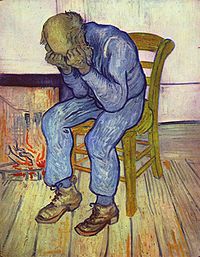
Vincent van Gogh


Vincent van Gogh: "I'd like to show by my work what such an eccentric, such a nobody, has in his heart"


How a genius feels: "I'm a nonentity, an eccentric, an unpleasant person"


March 30th is the birthday of Vincent van Gogh, born in Holland in 1853, a famous painter and also great letter-writer. His letters were lively, engaging, and passionate; they also frequently reflect his struggles with bipolar disorder.

He wrote: "What am I in the eyes of most people — a nonentity, an eccentric, or an unpleasant person — somebody who has no position in society and will never have; in short, the lowest of the low. All right, then — even if that were absolutely true, then I should one day like to show by my work what such an eccentric, such a nobody, has in his heart."

He wrote thousands of letters to his brother Theo over the course of his life. Theo's widow published the van Gogh's letters to her husband in 1913.


Be kind, for everyone you meet is fighting a great battle.
Plato Greek author & philosopher in Athens (427 BC - 347 BC)  


Image source: Vincent van Gogh's 1890 painting At Eternity's Gate. Wikipedia, public domain.


Monday, March 12, 2012

Psychologists and Psychiatrists Jokes at WorkJoke.com - Profession Jokes


Psychologists and Psychiatrists Jokes at WorkJoke.com - Profession Jokes


Link:  http://www.workjoke.com/psychologists-and-psychiatrists-jokes.html


A guy goes in to see a psychologist. He says, "It seems I can't make any friends. Can you help me, you fat slob?"

.....

Neurotics build castles in the sky.

Psychotics live in them.

Psychiatrists collect the rent.

......

A psychotic thinks that two and two are five.

A neurotic knows two and two are four -- but he hates it.

........

Welcome to the Psychiatric Hotline.

If you are obsessive-compulsive, please press 1 repeatedly.

If you are co-dependent, please ask someone to press 2.

If you have multiple personalities, please press 3, 4, 5, and 6.

If you are paranoid-delusional, we know who you are and what you want. Just stay on the line so we can trace the call.

If you are schizophrenic, listen carefully and a little voice will tell you which number to press.

If you are depressed, it doesn't matter which number you press. No one will answer.

If you are delusional and occasionally hallucinate, please be aware that the thing you are holding on the side of your head is alive and about to bite off your ear.


..............


A man goes to a Psychologist and says, "Doc I got a real problem, I can't stop thinking about sex."

The Psychologist says, "Well let's see what we can find out", and pulls out his ink blots. "What is this a picture of?" he asks.

The man turns the picture upside down then turns it around and states, "That's a man and a woman on a bed making love." The Psychologist says, "very interesting," and shows the next picture. "And what is this a picture of?"

The man looks and turns it in different directions and says, "That's a man and a woman on a bed making love."


......................................


The Psychologists tries again with the third ink blot, and asks the same question, "What is this a picture of?"

The patient again turns it in all directions and replies, "That's a man and a woman on a bed making love."

The Psychologist states, "Well, yes, you do seem to be obsessed with sex."

"Me!?" demands the patient. "You're the one who keeps showing me the dirty pictures!"


...................................................


A psychiatrist was conducting a group therapy session with four young mothers and their small children. "You all have obsessions," he observed. To the first mother he said, "You are obsessed with eating. You even named your daughter Candy."

He turned to the second mom. "Your obsession is money. Again, it manifests itself in your child's name, Penny."

He turned to the third mom. "Your obsession is alcohol and your child's name is Brandy."

At this point, the fourth mother got up, took her little boy by the hand and whispered, "Come on, Dick, let's go home."

...........................................


A very shy guy goes into a bar and sees a beautiful woman sitting at the bar. After an hour of gathering up his courage, he finally goes over to her and asks, tentatively, "Um, would you mind if I chatted with you for a while?" She responds by yelling, at the top of her lungs, "NO! I won't sleep with you tonight!" Everyone in the bar is now staring at them. Naturally, the guy is hopelessly and completely embarrassed and he slinks back to his table.

After a few minutes, the woman walks over to him and apologizes. She smiles at him and says, "I'm sorry if I embarrassed you. You see, I'm a graduate student in psychology, and I'm studying how people respond to embarrassing situations."

To which he responds, at the top of his lungs, "What do you mean $200?!


..........................................


What happens when a psychiatrist and a hooker spend the night together? In the morning each of them says: "120 dollars, please."


.....................


A young woman took her troubles to a psychiatrist. "Doctor, you must help me," she pleaded. "It's gotten so that every time I date a nice guy, I end up in bed with him. And then afterward, I feel guilty and depressed for a week." "I see," nodded the psychiatrist. "And you, no doubt, want me to strengthen your will power and resolve in this matter."

"For God's sake, NO!" exclaimed the woman. "I want you to fix it so I won't feel guilty and depressed afterward."

......................................


A psychologist is at a party talking with a small group of people, when a man comes up behind him and taps him on the shoulder. The psychologist turns around and the man hauls off and decks him. The psychologist gets up, brushes himself off, turns to the group and declares: "That's his problem."


...........................................


Two elderly couples were enjoying friendly conversation when one of the men asked the other, "Fred, how was the memory clinic you went to last month?"

"Outstanding," Fred replied. "They taught us all the latest psychological techiniques - visualization, association - it made a huge difference for me."

"That's great! What was the name of the clinic?" Fred went blank. He thought and thought, but couldn't remember. Then a smile broke across his face and he asked, "What do you call that red flower with the long stem and thorns?"

"You mean a rose?"

"Yes, that's it!" He turned to his wife. . ."Rose, what was the name of that clinic?"


......................................


What is the difference between a psychiatrist and a psychologist?

If you say to a psychiatrist "I hate my mother," he will ask "Why do you say that?" while a psychologist will say "Thank you for sharing that with us."


.............................


What's the difference between a psychologist and a magician?

A psychologist pulls habits out of rats!

.............................


Once I had multiple personalities, but now we are feeling well. I don't suffer from insanity, I enjoy every minute.

I used to be indecisive. Now I'm not sure.

The best thing about being schizophrenic is that I'm never alone.

Just because you are paranoid doesn't mean people aren't out to get you!

Hypochondria is the only illness that I don't have.

I've always been a hypochondriac. As a little boy, I'd eat my M&M's one by one with a glass of water.

......................


Psychiatrist to his nurse: "Just say we're very busy. Don't keep saying 'It's a madhouse.'"

.............................

Why is psychoanalysis a lot quicker for a man then for a women?

Because when it's time to go back to childhood, a man is already there.


...................................


A psychologist returned from a confrence in Aspen lodge, where all the psychologists were permited to ski for free. Her husband asked her, "How it went?". She replied, "Fine, but I've never seen so many Freudians slips."

.................


Two psychologists meet at their twentieth college reunion. One of them looks like he just graduated, while the other psychologist looks old, worried and withered.

The older looking one asks the other, "What's your secret? Listening to other people's problems every day, all day long, for years on end, has made an old man of me."

The younger looking one replies, "Who listens?"

..........................................


...............................


Patient: Doctor, my wife thinks I'm crazy because I like sausages.

Psychiatrist: Nonsense! I like sausages too.

Patient: Good, you should come and see my collection. I've got hundreds of them.


................................................


When the new patient was settled comfortably on the couch, the physiatrist began his therapy session, "I'm not aware of your problem," the doctor said. "So perhaps, you should start at the very beginning." "Of course." replied the patient. "In the beginning, I created the Heavens and the Earth..."

.........................

In a psychiatrist's waiting room two patients are having a conversation. One says to the other, "Why are you here?"

The second answers, "I'm Napoleon, so the doctor told me to come here."

The first is curious and asks, "How do you know that you're Napoleon?"

The second responds, "God told me I was."

At this point, a patient on the other side of the room shouts, "NO I DIDN'T!"


..........................


A man who thinks he's George Washington has been seeing a psychiatrist. He finishes up one session by telling him, "Tomorrow, we'll cross the Delaware and surprise them when they least expect it." As soon as he's gone, the psychiatrist picks up the phone and says, "King George, this is Benedict Arnold. I have the plans."

........................

Joe has been seeing a psychoanalyst for four years for treatment of the fear that he had monsters under his bed. It had been years since he had gotten a good night's sleep. Furthermore, his progress was very poor, and he knew it. So, one day he stops seeing the psychoanalyst and decides to try something different. A few weeks later, Joe's former psychoanalyst meets his old client in the supermarket, and is surprised to find him looking well-rested, energetic, and cheerful. "Doc!" Joe says, "It's amazing! I'm cured!"

"That's great news!" the psychoanalyst says. "you seem to be doing much better. How?"

"I went to see another doctor," Joe says enthusiastically, "and he cured me in just ONE session!"

"One?!" the psychoanalyst asks incredulously.

"Yeah," continues Joe, "my new doctor is a behaviorist."

"A behaviorist?" the psychoanalyst asks. "How did he cure you in one session?"

"Oh, easy," says Joe. "He told me to cut the legs off of my bed."

......................................


A psychologist was walking along a Hawaiian beach when he kicked a bottle poking up through the sand. Opening it, he was astonished to see a cloud of smoke and a genie smiling at him. "For your kindness," the genie said, "I will grant you one wish!" The psychologist paused, laughed, and replied, "I have always wanted a road from Hawaii to California."

The genie grimaced, thought for a few minutes and said, "Listen, I'm sorry, but I can't do that! Think of all the pilings needed to hold up the highway and how long they'd have to be to reach the bottom of the ocean. Think of all the pavement. That's too much to ask."

"OK," the psychologist said, not wanting to be unreasonable. "I'm a psychologist. Make me understand my patients. What makes them laugh and cry, why are they temperamental, why are they so difficult to get along with, what do they really want? Basically, teach me to understand what makes them tick!"

The genie paused, and then sighed, "Did you want two lanes or four?"

..........................


One behaviorist to another after lovemaking: "Darling, that was wonderful for you. How was it for me?"


........................

How do you tell the difference between the staff and the inmates at a psychiatric hospital? The patients get better and leave.

Not everyone of the patients thinks he is God.

The staff have the keys!

................................


Doctor, doctor, I keep thinking I am a set of curtains!

Pull yourself together, man! Doctor, doctor, I keep thinking I'm a bell.

Well, just go home and if the feeling persists, give me a ring.

Doctor, doctor, people tell me I'm a wheelbarrow.

Don't let people push you around.


 Doctor, doctor, I keep thinking I'm invisible.

Who said that?!

Doctor, doctor, nobody understands me.

What do you mean by that?

Doctor, doctor, People keep ignoring me!

Next!

Doctor, doctor, No one believes a word I say.

Tell me the truth now, what's your REAL problem?

Doctor, doctor, I feel like a pack of cards.

I'll deal with you later.

Doctor, doctor, people keep telling me I'm ugly!

Lay on the couch, face down.

Doctor, Doctor, I can't stop stealing things.

Take these pills for a week; if that doesn't work I'll have a color TV!

Doctor, doctor, I keep thinking I'm a spoon.

Sit there and don't stir.

Doctor, doctor, I'm manic-depressive.

Calm down. Cheer up. Clam down. Cheer up. Calm...

Doctor, doctor, I keep trying to get into fights.

And how long have you had this complaint?

Who wants to know?

Doctor, doctor, I can't concentrate, one minute I'm ok, and the next minute, I'm blank!

And how long have you had this complaint?

What complaint?

Doctor, doctor, I feel so short!

No problem. Hop up on the couch.

Doctor, doctor, I feel like a small bucket.

You do look a little pail.

Doctor, doctor, I've only got 59 seconds to live.

Wait a minute please.

Doctor, I have a ringing in my ears.

Don't answer!


Don't answer!


...........................................

Patient: Doctor, you must help me. I'm under such a lot of stress, I keep losing my temper with people.

Doctor: Tell me about your problem.

Patient: I JUST DID, DIDN'T I, YOU STUPID BASTARD!!!

........................................

Doctor, Doctor, I think I'm a bridge.

What's came over you?

Oh, two cars, a large truck and a coach.


..............................

Doctor, Doctor, I think I'm a cat.

How long has this been going on?

Oh, since I was a kitten!


...............................


Doctor, doctor, I keep thinking I'm a dog.

Lie down on the couch and I'll examine you.

I can't, I'm not allowed on the furniture.


...................................


How psychiatrists do it... Psychiatrists do it on the couch.

Psychiatrists think they do it.

Psychiatrists do it for at least fifty dollars per session.


......................................


How many psychologists does it take to change a light bulb?


None. The light bulb will change itself when it's ready.

Just one, but the light bulb really has to want to change.

Just one, but it takes nine visits. How many psychiatrists does it take to change a light bulb?

"How long have you been having this phantasy?"

"Why does the light bulb necessarily have to change?"

One, but he must consult the DSM-IV.

"How many do you think it takes?"


After 12 years of therapy, my psychoanalyst said something that brought tears to my eyes. He said, "No hablo Ingles."


- Ronnie Shakes (via Frederic Patterson)


A man walks into his psychiatrist's office and claims he suffers from CDO.

His doctor looks puzzled and asks what he means.

It's like OCD but everything has to be in alphabetical order!

- Emma Carter


There a naked guy, and he wraps himself in Saran wrap and goes to see a psychologist. He walks in, and the doctor says "Well, I can clearly see you're nuts!"
- Jose Jalapeno


Two psychologists pass each other in the hallway. One says to the other, "Hello!" After they pass, the second says to himself, "I wonder what he *meant* by that?"
- Jon James


I told my psychiatrist that I was talking to myself. I was surprised when he replied,

"That's o.k.. Just hold a mobile phone by your mouth."
- Robert D Dangoor


The head psychiatrist decides it's time to see whether some patients are ready to leave the "hospital" so he takes one to a room where there is a large, empty swimming pool, and a diving board overhanging it.

He takes the patient to the edge of the board and says: "Jump!" The patient jumps and breaks both his legs and is carried away.

The next patient is taken up and after the same injunction, jumps and breaks both her arms and is carried away.

The last patient is taken up and told to jump and he refuses.

The head psychiatrist says, "Congratulations! You have passed the test, and are free to leave, but tell me out of curiosity why you refused to jump." The patient replies, "I can't swim."

- David Crompton


Home | About Us | Links | Contact Us | Privacy Statement | Books | Cartoon

Our database has been compiled using various sources and feedback from users.

Therefore we cannot be held responsible for the authenticity of the jokes.


 Link: